
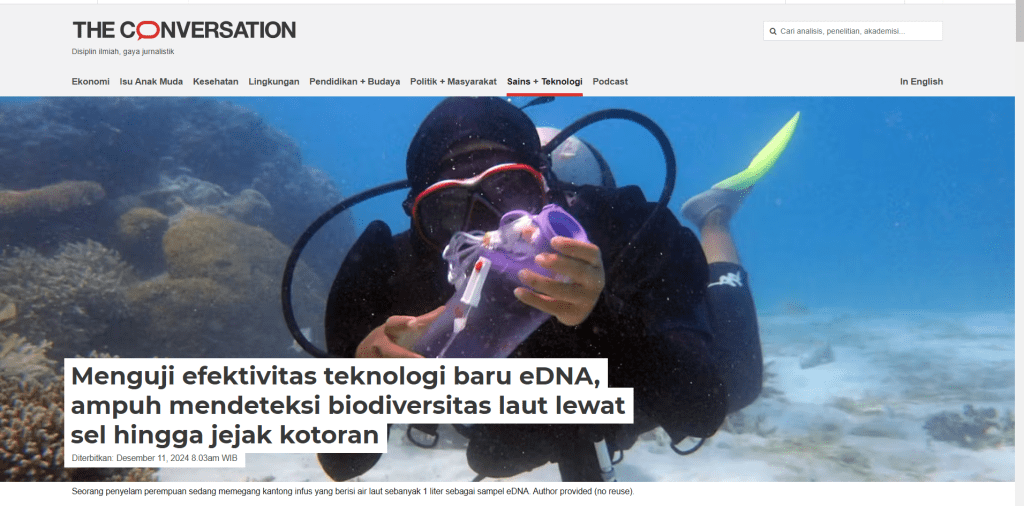
Indonesia’s marine biodiversity is one of the richest in the world . However, the effectiveness of its management still faces various challenges, one of which is the limited accurate biodiversity data. The data currently available is not adequate or representative enough to support the formulation of effective conservation policies. The process of marine biodiversity data collection in Indonesia still relies on visual census , a conventional method that involves direct observation on site. This method has many limitations , such as the process is time-consuming, only effective in waters with certain conditions, and the results are also very dependent on the expertise of the surveyor. As a result, the data produced is incomplete and a number of species are often missed. This has the potential to cause bias that impacts data accuracy. To overcome this problem, alternative methods are needed. We studied one of the biodiversity data collection methods that is currently developing and has been used in various countries, namely environmental DNA or eDNA.
That is what Danie explained in famous article at “The Conversation: Examining the effectiveness of new eDNA technology, detecting marine biodiversity from cells to trace the wastes” with our Lab Coordinator, Ni Kadek Dita Cahyani. This writing was also published at Tempo.co
Read more and click the link below to get futher information about our journey!
link: https://theconversation.com/menguji-efektivitas-teknologi-baru-edna-ampuh-mendeteksi-biodiversitas-laut-lewat-sel-hingga-jejak-kotoran-245278
https://www.tempo.co/lingkungan/edna-biodiversitas-laut-1180494?in=1&n_token=eyJ0eXAiOiJKV1QiLCJhbGciOiJIUzI1NiJ9.eyJ0b2tlbiI6IjAyNmYyYzcyYTFlOWEwMzIyMWM0M2U4ZWUyOTQxNWU3In0.3AUvXQo-0iytpvl6-xtAYmTq5r5zCKt2P3w67zGa8qk
 DIPONEGORO BIODIVERSITY PROJECT
Leave a comment